5 September 2024
 on life.
On 5 September 2024 Lat sat down at Monash University Malaysia with the painter Dr Jalaini Abu Hassan (Jai). The passages that follow are his own words from that conversation, lightly trimmed and set in four parts. Each sits beside one of his drawings.
“Dato’ Lat, to me, is a sense of hope.”

-

At the easel, starting his live sketch.
“I started off with the house”
When I drew the Kampung Boy, it was always the house. I started off with the house. … The house that I was born in is called Rumah Bumbung Lima. … Rumah Limas is a traditional Malay house.
-
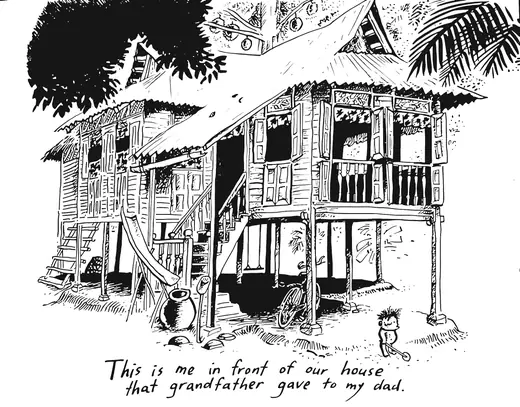
Drawing the roof and veranda of the house where he was born, built around the start of the Second World War.
“built by my grandfather”
You travel all over the peninsula and all over the Nusantara, you will find this kind of houses. So the house I was born in, the wooden house, was built by my grandfather. … It’s a very nice house with an anjung and the windows goes all the way down to the floor.
-
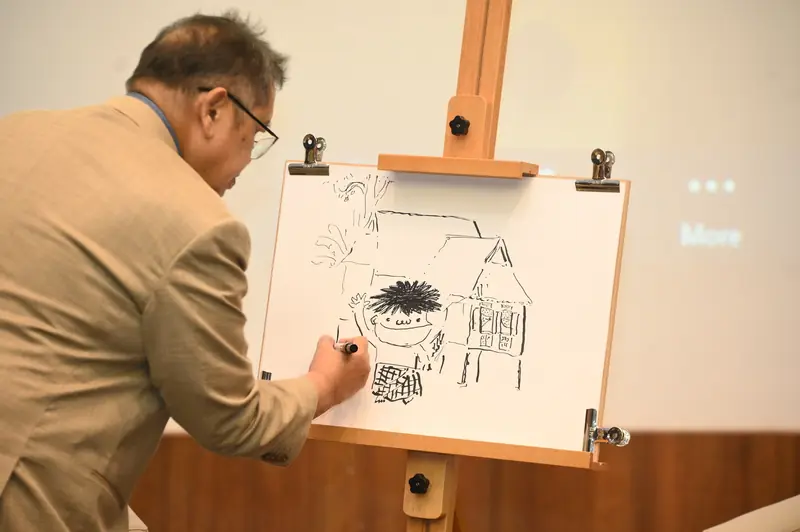
Jai remarks that the house appears all through the Kampung Boy; Lat adds the trees, then the boy.
“that’s me in better days”
It’s always in the background or in the middle ground. It’s always there. … We had a big durian tree. … And of course, that’s me in better days, standing in front of them all.
-
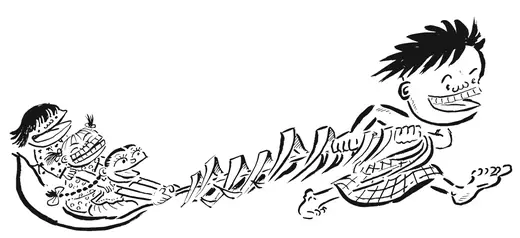
Comparing the cartoonists of the old days, who had only pen, brush and ink, with the boy he is drawing.
“he had really nothing”
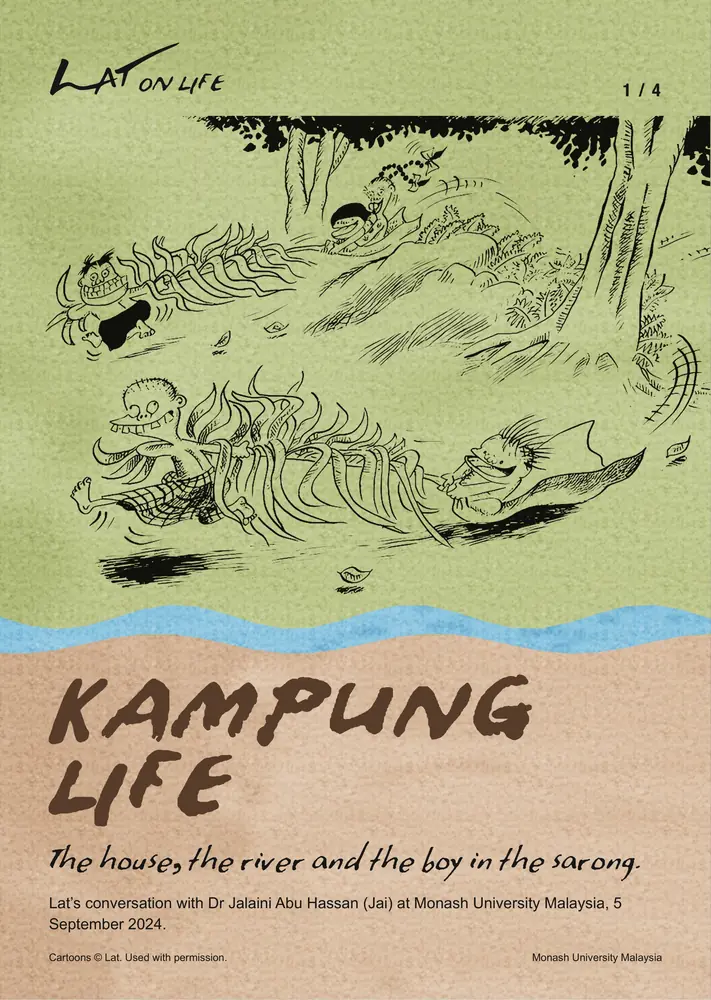
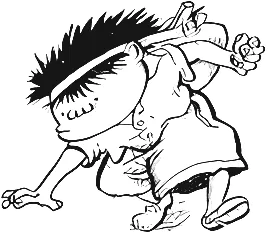
But if you met a kampung boy in those days, he had really nothing. He had no shirt and he wears sarong because the river is nearby.
-

On why the boy in his drawing wears a sarong.
“up river or down river”
That’s why the Kampung Boy usually would be wearing sarong like me. The river is nearby. Too bad, you jump into the river, you have to leave the sarong on the bank. And then the trouble is you don’t know whether you’re going to end up up river or down river. That means you got to come back and pick up the sarong.
-
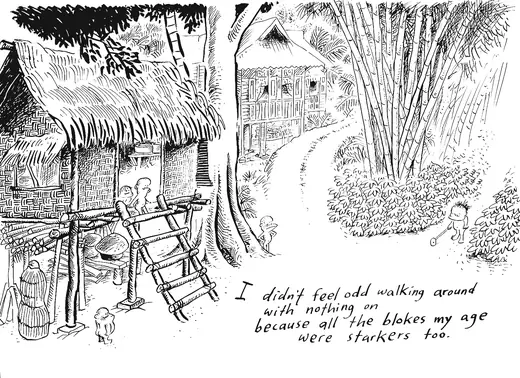
On the family photographs readers sent to a Jawi magazine in the 1950s, which his mother kept.
“he’s the youngest”
You have father, mother, grandma, all posing. But you also find one little boy naked. And he’s standing in front. … And if you told him that everybody got to dress up, he didn’t care. … He will stay. You couldn’t do anything. And he’s the youngest.
-
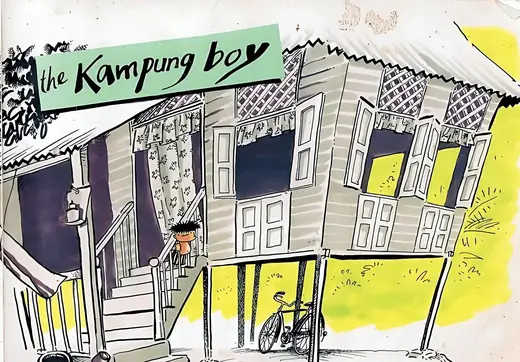
1978, in Bangsar: a book that included all of Malaysia was too big, so he drew one boy.
“I was missing home”
So to make it easy, I just draw about Malaysia, but this fellow in the kampung. So it’s much safer, and it’s based on my real story, which, sad to say, it was very dull. There’s nothing sensational. But I was missing home.
-
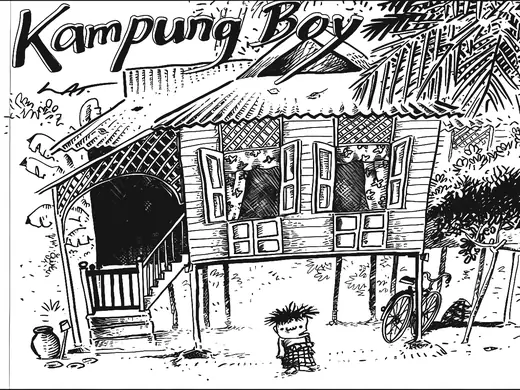
Finishing the sketch of the boy in front of the house.
“a simple story of what life was like”
So that’s Lat the Kampung Boy. Why we make it Lat? Because it’s his story. I’m not telling other people’s stories. I’m not putting down people, I’m not bringing up other people. I’m just telling a simple story of what life was like.
-
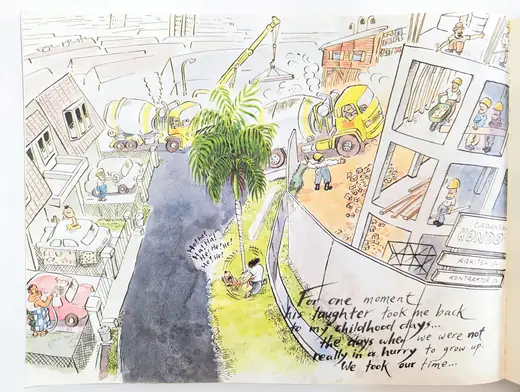
Straight after calling the Kampung Boy his own story.
“I was growing up everywhere”
Actually, I spent only a very short time in the kampung. My father was a clerk in the army and we moved from place to place. I was growing up everywhere.
-
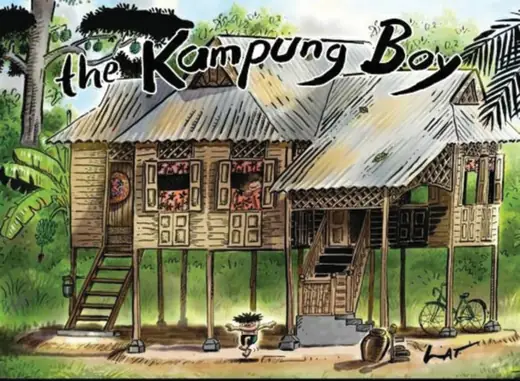
Opening the conversation, on leaving Kuala Lumpur for Ipoh.
“go back to my roots”
I moved back to Ipoh, where I come from, in 1997. … I was trying to say goodbye to my job, saying goodbye to Kuala Lumpur, which gave me my name and fame. … I started in 1970. It’s been too long, and I just wanted to go back to my roots. And eventually I did.



-

On how he got drawing paper as a boy; his father was a clerk in the army.
“paper given by my father”
I started off with paper given by my father. So he took papers from the office, big, big papers used for charts. He rolled them and cycled home and threw them at me. … That’s how he encouraged me.
-
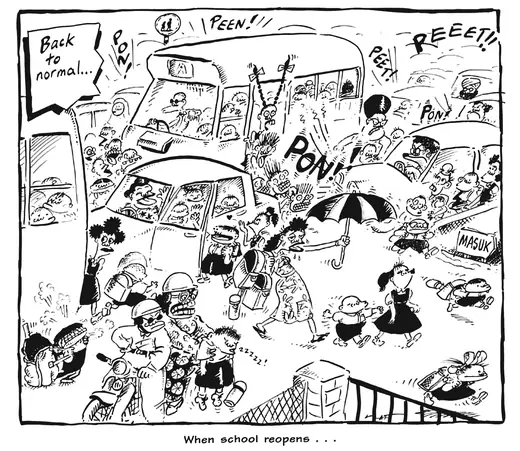
On moving from the village school to an English school, where he arrived knowing no English.
“I was from the kampung school”
I was from the kampung school, but the system was such that if you pass the special Malay class exam in standard 4, you end up in an English school in the big town of Ipoh. And I did.
-

Jai had mentioned 1964, the year his first cartoon was published, when he was 13.
“We learn English through songs”
64 was known for A Hard Day’s Night. A Hard Day’s Night came to Ipoh … and Beatles was number one then. We learn English through songs in those days.
-
Pointing to his drawing of Mrs Hew, his English teacher in Ipoh, on the screen.
“the fiercest teacher in the world”
She’s the one with the butterfly glasses. … She was the fiercest teacher in the world, but she was not that fierce looking. She’s pretty, but I had to draw her like that because everybody remember her. And she became my true friend later in my adult life. … She was the one who encouraged me to draw. … The late Mrs Hew was really special to me.
-

Still on Mrs Hew and the classrooms of his childhood.
“big thank you to the teachers of yesterday”
The reason why children learn fast, and the reason why the impact of learning was so great then, was because the teachers were fierce. … By tomorrow, you have to prove that you understand it. … She was either always with a cane or with a one-yard ruler. So, big thank you to the teachers of yesterday.
-
Jai asks which cartoonists were around when he started.
“we all wanted to be like them”
In the 1950s, there’s Raja Hamzah … who did all these comics about Raja Muda going fighting pirates in the sea. … They drew very beautiful drawings, and we all wanted to be like them.
-
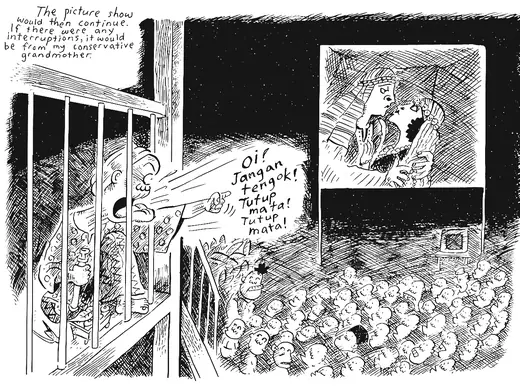
On Majallah Filem, the Singapore film magazine that printed readers’ cartoons, his own first one among them in 1964.
“My mum would buy”
My mum would buy. And it’s a nice magazine. And towards the end, two pages for the public to send jokes and drawings. So that’s where we found out about these people.
-
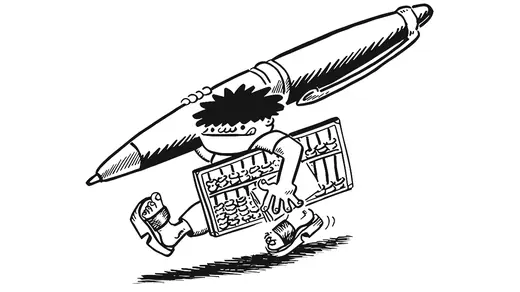
On how a schoolboy in Ipoh came to know other cartoonists.
“like a little brother”
When our names … came out frequent in the magazines, we got to know each other. And every cartoon that we sent, we have our name and address below it. So we could write to each other. … Those people who were really good, they were in KL, and I ended up meeting them every school term holidays. … But they were already working adults, and so they treated me like a little brother.
-
On arriving in Kuala Lumpur at 19 with a comic series already running.
“I was not a stranger”
I had already started drawing since Form 4, and my series Keluarga Si Mamat went on for many, many years since I was in school. So I was not a stranger when I came to Kuala Lumpur to work.


-
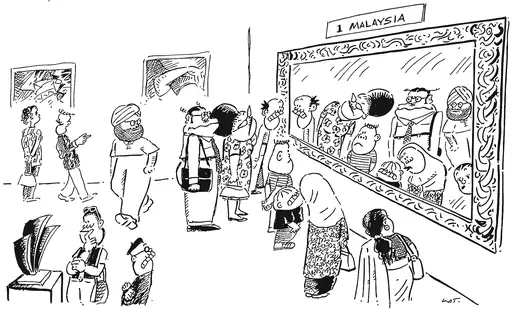
Jai asks what it is in his work that people love.
“I drew everybody”
When I was working for NST, the NST gave me the freedom. You draw what you like. … The story is this. I drew everybody. That’s the story. And in the 70s, we didn’t do that. In the 70s, we were talking about ourselves. But I drew everybody.
-

Kuala Lumpur, 1974: how his cartoon of a Sikh wedding began.
“I was eating chapati”
I was eating chapati in Malay Street. I had nothing to do. I was a bachelor and hanging around record shop. And then I went to pay for my chapati and drink. And the guy behind the counter was this Sikh fellow. And behind him was a picture of a wedding couple.
-

His answer to the shopkeeper, who had told him there was nothing funny about a Sikh wedding.
“if I draw like a comic”
I want to draw the story, draw in sequence. Draw for the newspapers. I want to draw the process, A, B, C, D. If I write a half page of an article about a Sikh wedding, nobody will read. … But if I draw like a comic…
-

The shopkeeper had told him of a wedding that Saturday at the Sikh temple in Kampung Pandan.
“not so long ago to me”
So I took the bus. … Those days the bus was there, no driver, no conductor. You are the only passenger waiting to go to Kampung Pandan. And 1974, not so long ago to me.
-

An uninvited guest at the wedding, his head covered as the shopkeeper had advised.
“people were so nice”
So I went to the temple, and I put a handkerchief. At that time, my hair was like Carlos Santana. And I went in, and people were so nice. We were sitting on the floor outside the temple, makan. They were handing out chapati, more chapati for me. And, of course, the dhal was in the pail, baldi. Plenty, plenty, makan, makan.
-

Closing the story of the Sikh wedding cartoon, which ran in the New Straits Times.
“through drawings in the papers”
This is the sort of thing that brought people together … through drawings in the papers.
-
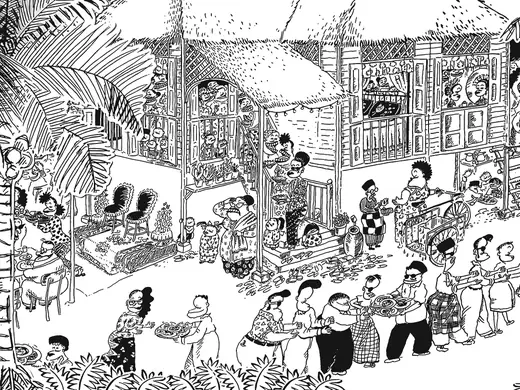
Describing his 1987 drawing of a Malay wedding, on the screen behind him.
“grooms are always late”
This is a wedding, kenduri. In the center is Mak Andam. She is on the lookout for the groom and his party to come, because she’s got to interrogate them. … This was before the arrival of the groom, and I didn’t draw the groom. As usual, grooms are always late. They go stuck somewhere, car tire punctured and so on.
-
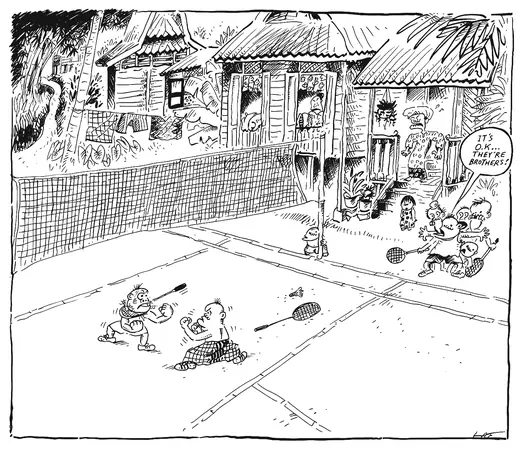
Looking at the crowd in the same wedding drawing.
“everybody is much freer”
This was drawn in 1987. There were no telephones then, no handphones then. That’s why everybody is much freer.
-

Two months travelling the United States in 1977, where people in cafes and bars asked him if Malaysia was in Alaska.
“you’ve got to include everybody”
I like to talk to people more, people in the street. … So I said, when I go back, I want to do a book on Malaysia. But to do a book on Malaysia, you’ve got to do a big book. Why? Because you’ve got to include everybody.
-
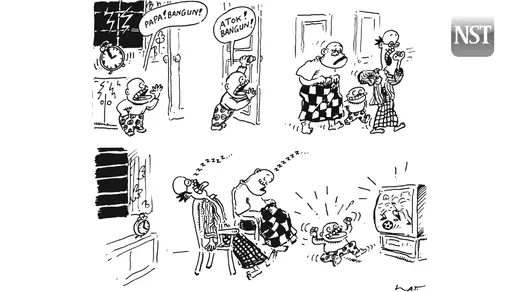
On the New Straits Times.
“I’ve had my time”
I worked for them for 40 years, 74 to 2014. Although in the end I was a freelancer, but I was an old faithful of that newspaper. Too bad today we don’t read newspapers anymore. And I’ve had my time, thank you very much.




-
On his first job in Kuala Lumpur, in 1970.
“it was a question of survival”
I started as a reporter, a crime reporter, and I was 19. And crime reporting is … the bottom most rank of the job in the newspaper. You are usually 18, 19 years old and you could … chase after fire engines, ambulances. You go and cover police stories. And I was always at the station, at the hospital, and I didn’t really enjoy the job, but it was a question of survival.
-
Jai had remarked on how consistent his line has stayed over 60 years.
“Everybody can have his own style”
It took years to get it. Everybody can have his own style, and it’s a matter of time before they can get it. You cannot get it the first couple of years. … The Malay comic illustrators of the 1950s, they use brush, and we try our best to be like them, but in the end, of course, we can get our own characters and our own style.
-

Jai had asked about the detail in every corner of his drawings.
“They just come out naturally”
You see, when I draw I got nothing in my head. Don’t think that I toil over all this. No, it’s quite easy. … Those characters are mine. They just come out naturally.
-
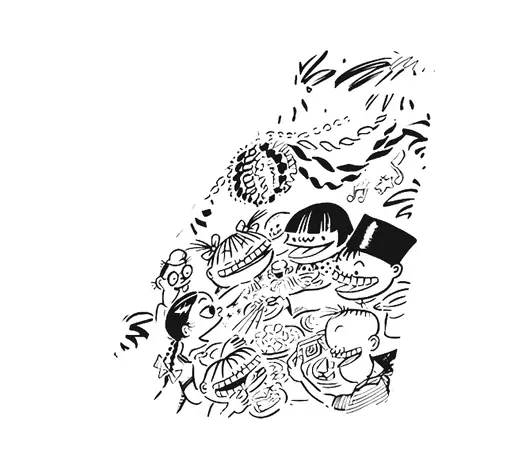
On composing a crowded scene.
“as large as possible”
You keep the characters as large as possible. … So in the end it’s a large thing.
-
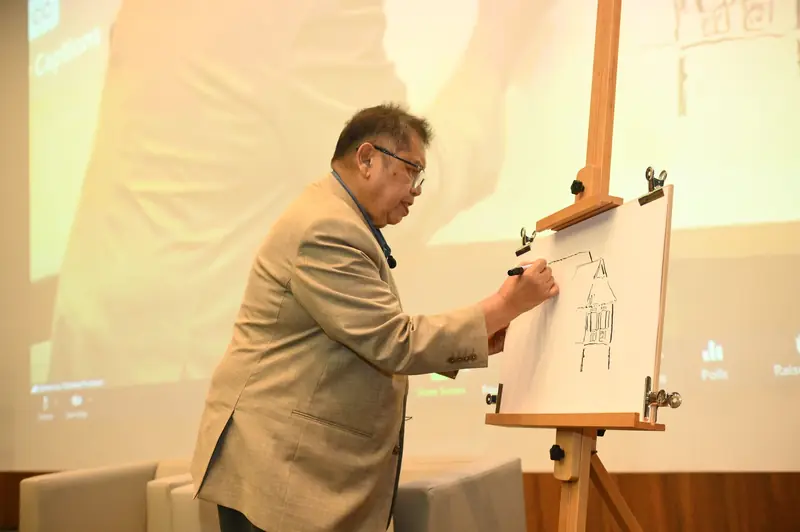
Standing up to draw at the easel.
“There’s no big secret here”
There’s no big secret here, it’s a simple drawing. … I normally use a dipping pen with a bottle of ink, and I use a brush, and of course I start off with a pencil. And I use an eraser. I’m still using all the old drawing utensils.
-
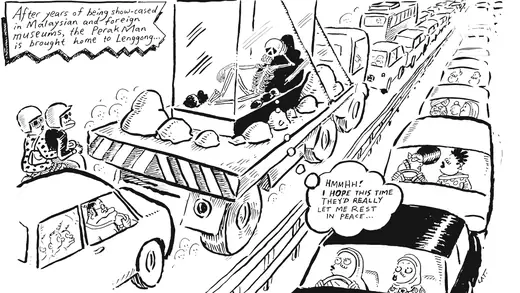
Sketching with a marker in place of his usual dipping pen.
“I would draw it in the car”
If you have a black pen … it’s already got ink in it, you don’t have to dip it. … You can even draw in your car. Because I worked last minute, some of the drawings I did for the newspapers, I would draw it in the car, because I deliver my drawings to the newspaper.
-
Drawing the Kampung Boy’s face.
“You better make him smile”
That’s the nose. It’s a question I can never answer. Why do you make the nose like that? … I say, I don’t know, but … I’ve seen noses like this before. So it’s okay. … You better make him smile.
-
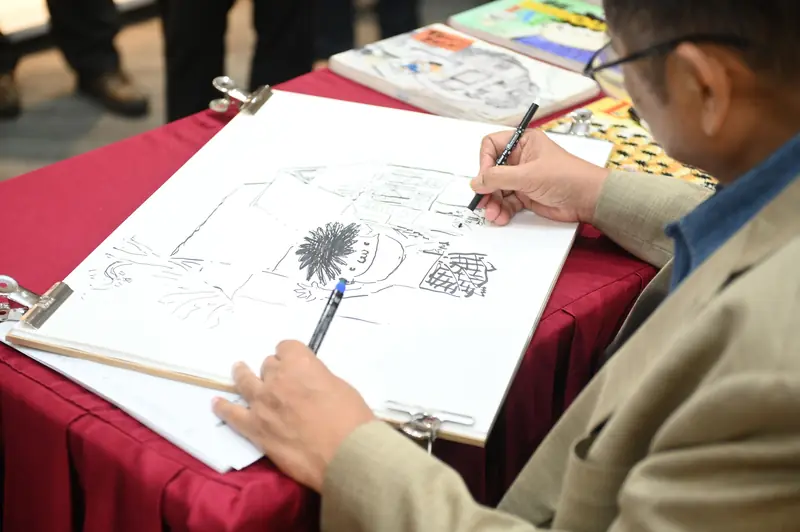
Signing the finished sketch.
“you are responsible for it”
For every drawing, you will sign your name because you are responsible for it. So I’ll sign it here.
-

His reply to Jai’s long opening question about what draws people to 60 years of his work.
“I’m here to talk about simpler things”
One day I’ll let you know. I’m here to talk about simpler things. And maybe I can get a cup of tea later.